


So much is troubling about the lawless war in Iran it’s small wonder when related news flies under the radar. For example, in the first days of the war, more than 200 service members submitted complaints with the Military Religious Freedom Foundation (MRFF) of their superior officers asserting that U.S. operations in Iran are fulfilling biblical prophecy.
The complaints span more than 40 different units spread across at least 30 military installations, involving commanders in every branch of the U.S. military, according to several sources, including The Guardian:
One complainant, identified as a noncommissioned officer (NCO) in a unit that could be deployed “at any moment to join” operations against Iran, told MRFF in a complaint viewed by the Guardian that their commander had “urged us to tell our troops that this was ‘all part of God’s divine plan’ and he specifically referenced numerous citations out of the Book of Revelation referring to Armageddon and the imminent return of Jesus Christ. He said that ‘President Trump has been anointed by Jesus to light the signal fire in Iran to cause Armageddon and mark his return to Earth.’”
Upon reading this report, I was instantly transported back to a small meeting room in the UCLA Student Union Building in 1968. A friend in our dorm invited me to hear a talk on biblical prophecy. About thirty of us found seats among the folding chairs as a stocky dark-haired man walked to the podium. While the local director for Campus Crusade for Christ introduced him, he opened his notebook and perused the room. His easy smile belied the dark intensity of his gaze. For the next hour, his voice filled the hushed meeting space, holding in thrall believer and nonbeliever alike.
This was 39-year-old Hal Lindsey, one year before his blockbuster book, The Late Great Planet Earth, was published. And one year after the 1967 Israel-Arab Six-Day War, won by Israel and resulting in the displacement of about 400,000 Palestinians and Syrians, laying the foundation for decades of simmering hatred and the recent war in Gaza. A Coast Guard veteran and a minister ordained in 1962 by Dallas Theological Seminary, Lindsey was now a key staffer in Campus Crusade. His profile was quickly rising as he spoke at colleges and universities around the country. He mesmerized with his coming-soon previews of Armageddon, drawing current events from the pages of the Old Testament and Revelation. The war between Israel and Arab countries was not a human tragedy but one of the pre-conditions for the return of Jesus Christ. Lindsey’s theology was based on uncovering prophesies that he could weave into a story of how true believers would be “raptured” and escape the destruction and suffering that God and the Anti-Christ would visit upon the Earth.
Lindsey’s topic was right for the zeitgeist of the late 60s: the Vietnam War and anti-War protests, war and permanent tensions in the Middle East, Cold War geo-politics, Civil Rights battles, Kent State, and the assassinations of Dr. King, JFK, and RFK. Credulous college students from a counterculture generation—like me—were an ideal test audience for the material of his book in progress.
For me the evening was a turning point. The stale religion of pulpit and pew paled next to the technicolor imagery depicted by Hal and others whose spiritual gravity would soon draw me into an orbit that, to this day, I find difficult to describe or explain. By the end of the 1970s, that pull had diminished. At 19 I couldn’t distinguish the messenger from the message. By 30, I had enough personal experience with the messengers of “God’s word” to recognize the dissonance—and the danger.
Which is why, when I read that the same prophetic promises I first heard from Hal Lindsey nearly six decades ago were now being used as motivational fodder within the most powerful military on earth, I was startled and alarmed.
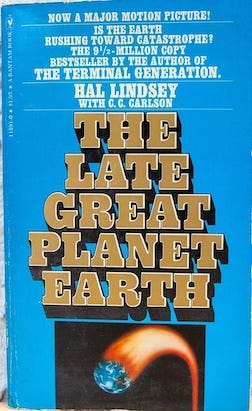
The Late Great Planet Earth sold an estimated 28 million copies and was the best-selling nonfiction book of the entire decade of the 1970s. It was followed by five successful sequels. But their influence was never primarily about book sales. Lindsey had cracked a code: he made dense, archaic scripture feel like tomorrow’s newspaper. His genius was translation—taking the specialized language of dispensationalist prophecy, developed by 19th-century Irish theologian John Nelson Darby and espoused by his seminary and rendering it as a geopolitical thriller accessible to anyone who had ever glanced at a headline.
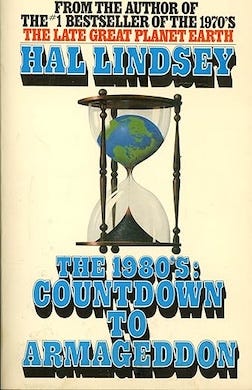
The architecture of that theology was specific. History was not random. It was scripted, moving through distinct divine epochs toward an inevitable climax. Israel’s rebirth as a nation in 1948 was the master signal, the “super-sign” that the final chapter had begun. Persia—modern Iran—was named in the ancient prophecies of Ezekiel as one of the nations that would march against Israel in the end times, triggering the final battle at the Plain of Megiddo, which the Book of Revelation calls Armageddon. Most critically, Armageddon was not a catastrophe to be prevented. It was a promise to be welcomed. The blood and fire were not a failure of human diplomacy—they were a prerequisite for the return of Jesus Christ. The more graphic the battle, Lindsey taught, the more certain the fulfillment.
This is the framework now audible in the MRFF complaints. When a combat commander tells his troops that the Iran war is “all part of God’s divine plan” and cites “numerous citations out of the Book of Revelation referring to Armageddon,” he is not improvising a personal theology. He is reciting, with remarkable fidelity, the eschatological script that Lindsey spent years preaching on college campuses and then embedded in a series of books that shaped the religious imagination of tens of millions of American evangelicals—many of whom grew up, entered the military, rose through the ranks, and are now in positions of command authority. When another commander declares that President Trump has been “anointed by Jesus to light the signal fire in Iran,” the phrase “signal fire” is not casual metaphor. In Lindsey’s framework, and in the broader dispensationalist tradition he popularized, the events in Iran are precisely that—signals, fulfillments, checkmarks against a prophetic timeline that ends with the physical return of Christ to Earth.
What makes this moment constitutionally alarming, beyond the individual complaints, is the institutional context in which it is occurring. Defense Secretary Pete Hegseth sponsors a weekly Pentagon Bible study whose leader teaches that God still blesses Israel’s allies and curses Israel’s enemies. The Supreme Court’s 2022 decision in Kennedy v. Bremerton lowered the wall between government and religious expression that had stood for 75 years. And the Trump administration has, in the words of MRFF founder Mikey Weinstein, given commanders who share these views the sense that they are “fully supported and justified by the entire chain of command.” Twenty-seven members of Congress have now asked the DoD Inspector General to investigate. But the question they are really asking is one that Hal Lindsey’s audiences never had to consider: what happens when the story becomes the directive?
When I wrote How Can Christians Support Donald Trump? just before the joint US-Israeli attack on Iran, I hadn’t realized that Hal Lindsey’s form of eschatology had survived the decades ready to resurface and be weaponized in our time. I shouldn’t have been surprised though. Lindsey, who retired at 89 and died at 95 just over a year ago, built a lucrative 6-decade career as an author and a television personality entirely on a single sustained argument: current events are fulfilling prophecy, Armageddon is near, here’s the timeline.
Writing this, I’m reminded that the timeline was what first penetrated my credulity, planting some healthy skepticism. Lindsey based his narrative on the infallibility and divine inspiration of the Bible. Yet, it was all human interpretation. He would give both implicit and explicit evidence that certain events would occur at or within a particular timeframe. When those times would come and go, there would be repeated reinterpretations of scripture to re-validate the prophecies to keep his theology—and the income stream—going.
This theology, made menacing by its proximity to political power and military might, further strengthens the unholy bond between Christian nationalists and Trump. Anyone in its sway has greater reason to see the president as a vessel of God who will usher in the long-awaited end times. Their misfortune—and our best hope—is that Trump is lacking the perseverance of a Hal Lindsey but possesses the attention span of a gnat.
I like your description of the period when we knew you. "Difficult to explain."