

[Note: We got back this weekend after 8 days somewhere wonderfully warm. First on my To Do list was finishing this article. I’ve resisted writing it for years now, reluctant to reopen internal doors I closed nearly 40 years ago when I walked away from the church.]
I came back today to an Atlantic article I had skimmed recently and bookmarked for later. Occasioned by the annual National Prayer Breakfast, the title — “The Evangelicals Who See Trump’s Viciousness as a Virtue,” by Peter Wehner, Republican, Christian, and former speechwriter for Reagan and both Bushes — might catch anyone’s eye. But it struck an added chord for me because I have followed and admired Wehner’s writing since early in Trump 1.0. And it provoked the familiar emotional mix of anger and sadness at the incongruous support of Trump by people professing a Christian faith. How can Christians condone the president and their own complicity in his rise to power?
I first need to point out what most people know but too often fail to take into account: no religion, no political party, no nationality is homogeneous. Good luck finding widespread agreement even on what it means to be a Christian. For now, let’s accept the premise that Christianity is composed of all those who consider themselves Christians.
Sojourns during my first 40 years within various flavors of Christianity—mainstream Protestantism, the Jesus Movement, and an earlier form of Evangelicalism—taught me that the most salient distinction among Christians is how central Christ himself is to their lives, even more than denominational or doctrinal differences.
There are Christians who believe Jesus alone is the foundation of their lives. They may believe they have the spirit of God living in them. They may believe Jesus speaks to them through the Bible. Their faith is very personal and it may or may not include being a member of a church. If it does, it will ideally be a church where the role of the pastor is to help guide people into a closer spiritual relationship with Jesus, not to be a purveyor of God’s will.
These Christians are unlikely to be politically active. They may pray for our leaders but are more likely to consider themselves part of the kingdom of God— “in the world, not of the world.”
Then there are the Christians who believe Christ to be important, but not all-important in their faith. I’ve heard that called Jesus Plus. They might have worn the WWJD? (what would Jesus do?) bracelets when they were a thing. They depend upon the Bible, but also religious leaders to interpret it. If they are part of a congregation, the specific doctrines and traditions of their church or denomination are important factors in what they believe and how they conduct their lives.
They might or might not feel they have a personal relationship with Jesus. They certainly believe the Bible provides a rich source of his teachings and that those teachings are relevant to their lives. They may or may not have strong political views, as might their specific church. They may elevate certain causes and cultural stances as their central purpose, at least for a time.
Finally, there are the Christians for whom Christ in their lives and their churches is incidental, possibly even irrelevant. They may be drawn to a particular congregation for any number of reasons—a non-specific desire for religious ritual, social or business ties, family history, or political persuasion. Their pastors or priests may or may not give Biblically-based sermons and may or may not let partisan political views into the pulpit. These Christians may consider their church as a means to some end—getting into heaven, social status, business advantage. They may see their church as part of a national movement to accomplish societal and political change.
Some of these Christians might be totally untethered to any church or religious organization, but they find themselves on the same side of the cultural and political issues that Evangelicals and Christian Nationalists tend to embrace.
Now, before you jump to my conclusion, let’s get back to the teachings of Jesus. I’m hoping you’ll see why for many Christians it is intrinsically impossible to support Donald Trump, even if they are longtime Republicans.
According the book of Matthew, Jesus began his teaching ministry at the Mount of Olives, when he saw a crowd gathered there. We know this as the Sermon on the Mount. He led off with a series of blessings, which we call the Beatitudes:
Blessed are the poor in spirit,
for theirs is the kingdom of heaven.
Blessed are those who mourn,
for they will be comforted.
Blessed are the meek,
for they will inherit the earth.
Blessed are those who hunger and thirst for righteousness,
for they will be filled.
Blessed are the merciful,
for they will be shown mercy.
Blessed are the pure in heart,
for they will see God.
Blessed are the peacemakers,
for they will be called children of God.
Blessed are those who are persecuted because of righteousness,
for theirs is the kingdom of heaven.
Blessed are you when people insult you, persecute you and falsely say all kinds of evil against you because of me.
Rejoice and be glad, because great is your reward in heaven
—Matthew 5:3-12
Later in the Sermon is what we refer to as “The Golden Rule”:
So in everything, do to others what you would have them do to you, for this sums up the Law and the Prophets.
—Matthew 7:12
At a later date, he spoke of the scene on Judgement Day:
Then he will say to those on his left, ‘Depart from me, you who are cursed, into the eternal fire prepared for the devil and his angels. For I was hungry and you gave me nothing to eat, I was thirsty and you gave me nothing to drink, I was a stranger and you did not invite me in, I needed clothes and you did not clothe me, I was sick and in prison and you did not look after me.’
They also will answer, ‘Lord, when did we see you hungry or thirsty or a stranger or needing clothes or sick or in prison, and did not help you?’
He will reply, ‘Truly I tell you, whatever you did not do for one of the least of these, you did not do for me.’
—Matthew 25:41-45
These are just a few examples of the revolutionary nature of Jesus’s message. The religious leaders of his time viewed him as a threat to their position and power.
There are “red letter” versions of the Gospels in which everything Jesus says is in red print. Anyone today reading just those words would be confronted with clear precepts that align with today’s left-leaning concerns with social justice, income inequality, the common good, and so on. Christians who find themselves on the other side of the partisan divide must either reject the precepts or live with the dissonance.
One of the most effective weapons Trump has in his arsenal is the ability to stoke grievances in his supporters—and there is a natural spring of grievance to be found in Christianity. From the crucifixion of Jesus and the persecution of the early church through centuries of countless shades of religious persecution and warfare, Christians have it in their DNA that someone is out to get them.
More often than not, that someone has been the state. As the Roman Catholic Church grew in power and wealth, it would at first compete and then coalesce with kings and emperors. After the Reformation these unholy alliances would continue in Protestant nations as well.
The result was the state church.
For example, in 1534, England’s Parliament passed the Act of Supremacy, declaring King Henry VIII “Supreme Head of the Church of England,” canceling the Pope’s franchise and clearing the way for the king to divorce Catherine of Aragon. He was the first head of state given the unofficial title of “Defender of the Faith.” The faith he was defending was effectively the religious branch of the state. This really wasn’t a good time to be Catholic in England. There were executions, confiscation of property, and other punishments for those who denied fealty to the new church.
Much of the early emigration from Europe to America was to escape the religious persecution that resulted from refusing to abide by the dictates of state churches, or at least the churches favored by the state. It was therefore important to our founding fathers to preserve religious freedom, which they did with the First Amendment to the Constitution: “Congress shall make no law respecting an establishment of religion, or prohibiting the free exercise thereof…” In 1802, Thomas Jefferson introduced the phrase we now associate with the Amendment, that it builds “a wall of separation between Church & State.” And in 1947, the Supreme Court decision in Everson v. Board of Education cites Jefferson’s phrase, thus strengthening the principle.
Until 2022 that is, when the current Court’s decision in Kennedy v. Bremerton School District changed the interpretation to lower the wall. For nearly 250 years, the First Amendment has guaranteed free expression to all religious faiths without governmental favoritism. Now the door has been cracked open to the possibility of government joining forces with a radical religious minority.
Should we worry about this?
Consider that the term “Defender of the Faith” is being ascribed to Trump in various ways. You can order a 2025 book from Amazon with Trump’s prayerfully bowed visage on the cover with the title, “Defender of the Faith: A Call to Action: Protecting America’s Legacy of Faith and Freedom.”
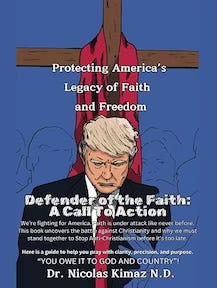
In 2024 the Washington Post published an article titled, “Pro-Trump Christian extremists use scripture to justify violent goals.”
To his most zealous Christian supporters, Donald Trump’s campaign is a crusade against “evil” liberal forces that must be vanquished by any means necessary to save the republic. Democrats aren’t opponents, but enemies to be “smited.”
Despite never being particularly religious, Trump in recent years has played to the hard-right Christian view of him as a beleaguered defender of the faith, including comparing his legal troubles to the trials of Jesus.
And at this year’s National Prayer Breakfast, Trump recounted comments made about him by Robert Jeffress, the senior pastor of the First Baptist Church in Dallas and a stalwart Trump ally for a decade. The case Jeffress made on his behalf went like this:
“He may not have ever read the Bible, but he will be a much stronger messenger for us…I want the meanest, toughest SOB I can find to protect this nation.”
As reported by Wehner, the “prayer” breakfast was dominated by the president’s rambling, 75-minute speech in which the room saw the quintessential Trump. His comments were grievance-filled, narcissistic, conspiratorial, factually false, divisive, and insulting. This was the same Christian hero who said at Charlie Kirk’s memorial service last September, “I hate my opponent and I don’t want the best for them.” The same one who has presided over the most inhumane treatment of immigrants in decades.
As he finally wrapped up, the audience of about 3,500 Christians gave Trump a standing ovation.
I have heard and read about those who claim to love and admire Donald Trump. Some of those are probably Christians. I have nothing to say about them as understanding eludes me. But all other Christian Trump supporters see in him a means to their ends. Whether believing he will come through as a defender of their faith or seeing an alignment between his agenda and their religious and cultural issues, they have decided such a man is worth the price of their allegiance.
That price is simply too great for those who put more faith in one whose precepts are, in almost every way, diametrically opposed to the words and example of Donald J. Trump.
Very informative and insightful. I don't know how anyone with a shred of humanity can support trump.
You summed up the issue well. Christianity to Trump is a political ploy, strategic rather than spiritual, not a belief he has held or understood. Your siting of the Beatitudes points out the discrepancies.