

Submitted for your consideration: An independent voter in Saint Louis — let’s call him Sam — suffers a brain injury in a car accident on the eve of the 2016 presidential election. He emerges from a semi-coma in February of 2021. Sam would tell you that living through the tail end of the COVID-19 pandemic was the most disorienting thing he experienced after awakening — more so than the charged political climate, the widening chasm between Red and Blue, even the failed insurrection. The government is still functioning. Things in the nation’s capital seem fairly normal — even if his memory of “normal” is faint praise indeed.
Now consider that Sam’s accident occurs on the eve of the 2024 election and his coma lasts until 2028. As a good stand-up comedian might tell you, “It’s all in the timing.”
It is not, for example, a good time to have been a full-time hospital patient. Shrinking insurance options and ballooning premiums have forced Sam’s wife into bankruptcy and Sam onto Medicaid. Vanishing Medicaid funding is closing about one-third of Missouri’s hospitals. The remaining hospitals — which depend heavily on foreign-born staff — have been decimated by immigration raids, detentions, deportations, and the climate of fear that drives others into hiding. The One Big Beautiful Bill of 2025 allocated nearly $100 billion for enforcement while simultaneously gutting the immigration court system that had been the last modicum of due process for those caught in its net. The hospitals are just a microcosm.
When he’s stable enough, Sam’s wife drives him to her parents’ — with whom they will be living for the foreseeable future. There are few news programs and newspapers his in-laws feel they can trust. Over the following weeks Sam pieces together what he’s missed: the 2026 mid-terms produced a Blue wave, but court challenges in most Blue states were upheld by the Supreme Court in early 2027, handing Republicans large majorities in both chambers and most state legislatures. In the lead-up to the ‘28 election, swelling protests against gerrymandering and voter suppression are being met with threats of martial law.
The Sam who missed the first Trump term missed a presidency characterized by narcissism and incompetence — one prevented from inflicting its intended structural damage by a critical mass of governmental, military, and civilian professionals who stood in its way. Not that he was harmless. But the institution — the executive branch and its agencies — was still intact. The next administration had nearly the same organization and resources at the ready as the preceding administrations did. Policies changed, but not the government.
A very different story for Sam 2.0.
In February 2017, Steve Bannon spoke at the Conservative Political Action Conference (CPAC) and for the first time publicly used the phrase, “deconstruction of the administrative state.” Anarchic and reckless as it sounded, it communicated something essential: a fundamental disdain for the status quo. His less cerebral echo would sound at the beginning of Trump’s second term in the person of Elon Musk — an accident of circumstance, perhaps, having ingratiated himself with the impulsive Trump and been given free, albeit temporary, rein to take a chainsaw to government agencies.
Meanwhile, with considerably less fanfare, Project 2025 was formally established in 2022 and its document quietly published in April 2023. It was the progeny of various stages of work by the Heritage Foundation, beginning in 1981. Where Bannon wanted to tear the administrative state down, Project 2025’s architects concluded that demolition alone was insufficient. The administrative state would instead be selectively dismantled where it protected citizens and provided life-saving aid to the global community — public health infrastructure, regulatory agencies, civil service independence, USAID — and simultaneously expanded and repurposed where it could be weaponized for authoritarian ends. ICE wasn’t deconstructed; it was tripled. The machinery of government wasn’t abandoned; it was captured and redirected.
With lessons learned from the first Trump term, Project 2025 produced a 180-day agency-by-agency playbook and a personnel database of ideologically vetted, loyalty-tested candidates trained and ready to step in on day one. The results were immediate: four days into the second term, nearly two-thirds of Trump’s executive actions already mirrored the Project’s proposals.
To those of us living through the years Sam slept, it often seemed that chaos and incompetence were behind the fire hose stream of alarming news. And that was often the case. But what looked like chaos was also the completion of a declared agenda. What looked like impulsive destruction was disciplined execution of a blueprint composed during the four years between Trump presidencies — itself the latest iteration of a project dating to Reagan. The people who built it were explicit that they were playing a long game, aiming to roll back not just Biden-era policy but the New Deal, the Great Society, the Voting Rights Act, and the civil service reforms of the 1880s.
Yes, the 1880s. The assassination of President James Garfield by Charles Guiteau, a deranged office-seeker, galvanized public outrage over the spoils system — the practice dating to Andrew Jackson’s era of filling government positions with political loyalists regardless of competence. The Pendleton Civil Service Reform Act of 1883 established the foundational principle that federal jobs should be awarded on the basis of merit rather than political loyalty, a bedrock assumption of professional democratic governance that expanded steadily over the following century.
Among those first 100-day executive actions was Schedule F, so named because it created a new employment schedule category within the existing federal civil service classification system. It reclassifies tens of thousands of career civil servants as political appointees who can be dismissed and replaced with loyalists — a restoration, in the most literal sense, of the spoils system that Garfield’s assassination made politically untenable 140 years ago.
Sam 2.0 can already see things that are different — literally. The White House and Trump’s name installed on the Kennedy Center and other public buildings. Gold statues. A triumphal arch. But these are surface details. What will take him much longer to reckon with lies beneath.
Bannon’s “deconstruction” and Project 2025’s demolition combined with authoritarian repurposing share a single goal: to shrink and reconfigure government so radically that rebuilding becomes prohibitively difficult for any successor. Eliminate the agencies, disperse or drive out the expertise, break the institutional memory — and the next administration faces not a policy reversal but a rebuilding project of indefinite duration.
Let’s leave Sam in 2028, where things are frankly rather bleak, and turn our attention to today in 2026. Also bleak, admittedly — but the last 32 months of Trump’s term have yet to occur, and the mid-term elections haven’t taken place yet. True, the Supreme Court and Southern legislatures are working hard to tilt the electoral playing field. But American public opinion is tilted the other way — measurably and sharply. Two-thirds say the country is headed in the wrong direction. Trump’s approval rating stands at 37% with disapproval at a record high of 62%. Majorities disapprove of how he is handling every issue measured. (ABC News/Washington Post/Ipsos)
But wait. The Democratic Party isn’t too popular either. Its favorability stands at just 30% among all voters, with only 62% of Democrats themselves viewing their party favorably — a paradox, given that the policies associated with Democrats are popular with voters nearly across the spectrum while Republican policies are deeply unpopular.
People in this country are sick of both parties and their politics. There is a growing conviction that both sides are disconnected from the people our government is meant to serve. On the left, the cause is a combination of fecklessness and the corroding influence of multi-million dollar campaign financing. On the right, the cause is complicated but traceable.
In 2013, two years before Trump announced his candidacy, Bannon began meeting with wealthy donors and pollsters who were convinced a large, disaffected populist constituency was waiting to be mobilized with the right catalyst. During the 2016 campaign, then-Heritage Foundation president Jim DeMint reached out to Trump to offer free policy advice to his low-budget campaign. Trump provided the personality and the popular response neither Heritage nor Bannon could have generated on their own. The billionaire donor class provided the money. Each party got what they needed, and the country got Trump.
Even so, the institutions withstood the first term — battered but intact. Bannon was banished early on. Heritage advisers probably found Trump preferred to “go with his gut” rather than their advice. Trump left office in defeat, twice impeached and disgraced, having inspired an insurrection and an attempted overthrow of an election — and escaped accountability for it in ways that remain difficult to fully comprehend.
Meanwhile, Heritage made use of the Biden years to organize and prepare for their next opportunity. They couldn’t know that Trump would return, nor that he would return with Republican control of Congress. But in 2022 they launched Project 2025 just in case.
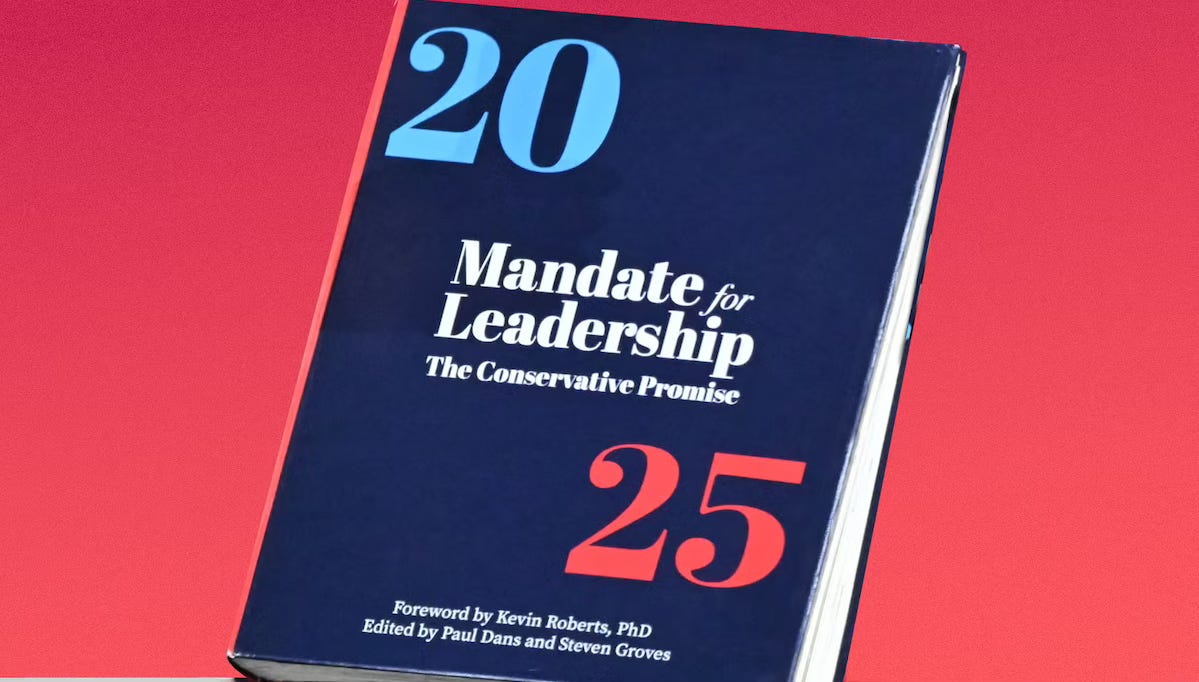
The coalition Heritage assembled — officially the “2025 Presidential Transition Project,” Project 2025 for short — eventually grew to more than 100 conservative organizations. The concentration of funding behind them tells the real story: about 50 received major donations from the same six billionaire family networks, including Koch, Bradley, Scaife, and Coors. The resulting document, Mandate for Leadership: The Conservative Promise — the ninth edition of a Heritage series dating to 1981 — was 920 pages long, written by fewer than 400 conservatives, many of them veterans of Trump’s first administration, and funded to the tune of $120 million or more from those same six families.
Project 2025 is, at its core, an elite capture operation — a relatively small number of wealthy donors, think tank professionals, and ideologically vetted operatives who built infrastructure sophisticated enough to redirect the policy of a nation of 330 million people. The vehicle was a handful of billionaires, 100 organizations, and fewer than 400 authors — working from a four-decade foundation of previous Heritage work to produce a 920-page blueprint for seizing the machinery of democratic governance.
It looks bleak. But there are genuine silver linings. One is the possibility of winning enough seats in November to apply the brakes. Another, oddly, is Trump himself — who is as much a problem for Heritage as he is for the rest of us. In addition to being historically unpopular, he continually undermines their disciplined plans. Chainsaw-wielding Elon and the DOGE operation were not in Project 2025. Neither was joining Israel in a war with Iran, the increasingly erratic social media posts, or the unprecedented personal grifting. The architects of Project 2025 wanted a disciplined executioner of their blueprint. They got Trump.
Our country has been hijacked by a tiny minority with a toxic, cynical vision enshrined in a document subtitled The Conservative Promise. Its goals are oligarchy defended by authoritarianism. It can be defeated — but not by a political party alone, and not in a single election cycle. The Civil Rights Movement took decades. So did Project 2025. The democratic response will too, though it starts with November.
It must be a movement, not a campaign. We need leaders with the vision and humility to subsume personal ambition to the goal of rebuilding democratic governance — and a citizenry willing to hold them to it. It may take years, even decades. But we must start now.
Eyes on the Prize.