

“Safety and security don’t just happen, they are the result of collective consensus and public investment. We owe our children, the most vulnerable citizens in our society, a life free of violence and fear.” -commonly attributed to Nelson Mandela
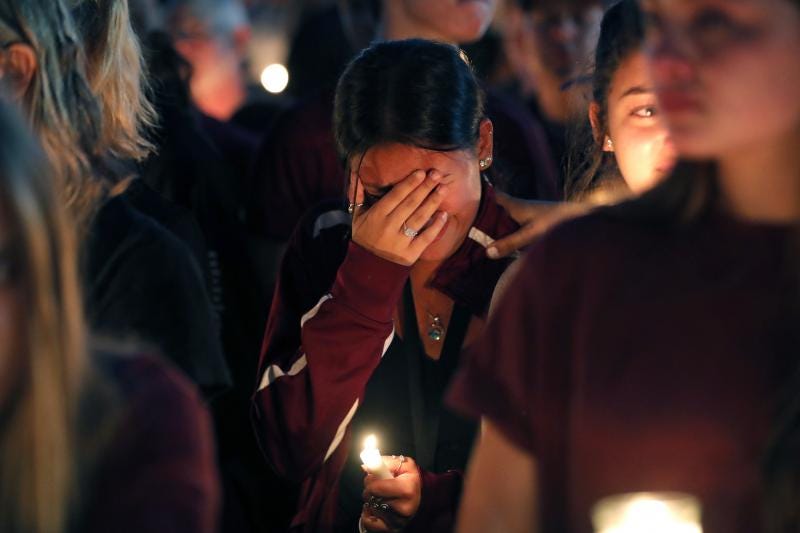
With students safely loaded on buses and ushered homeward in crosswalks by a flag-armed safety patrol, several staff members began to file into the library for yet another after-school meeting. As we pulled up child-sized chairs around the well-worn tables, this looked like any of hundreds of gatherings we had all attended. Like any of thousands around the country any day of any week. But this one was different. Since Columbine, a new responsibility had appeared on the job description of public schools and educators. To reading, writing, computing, critical thinking, sex ed, AIDS, bullying, and reporting suspected abuse, now added was how to keep our kids safe from an armed intruder. Unofficially, we also understood the implied duty to throw one’s body over students as a shield against an assault rifle. Our job today was to consider the more mundane parts of our safety plan.
“Not all of my windows have blinds to close during the lockdown. I’ll have to cut black tag board to fit over those.” “Sounds good…if you have time to tape them up when the time comes.”
“We’re supposed to keep our students under their desks or tables and away from the doors. But won’t they just be sitting ducks if he (no one ever said “she”) gets in somehow?” “Speaking of getting in, with the center room, we have 3 doorways into the classroom. They will all have to be checked and locked. Meanwhile I have 23 frightened first-graders to keep quiet and calm under their desks!”
“We need to talk about what to do if it happens during a recess and we have 200 children spread around outside.” “Yes, we’ve identified gathering points in three neighborhoods adjacent to our grounds. Playground supervisors and available teachers need to lead students directly away from the school and to those spots.” It was quiet for a full minute as everyone stared vacantly, imagining the scene of adults bellowing into bullhorns as others tried tried to herd happy playful children away from danger. Tears welled in the eyes of a second grade teacher.
And so it went. Every solid idea added to the plan was accompanied by two or three new questions to resolve.
In the years right after Columbine, meetings like this seemed mostly an obligation to plan for an event that could never occur in our school. An exercise in empathy for colleagues in a far away city. Gradually, as violence is visited on schools again and again, the unimaginable has become expected, reinforced by similar horrors in nearly every other type of public venue. Yet, a school shooting remains unique in the visceral response it produces. Or should produce.
Parkland has caused me to return to the blog today after more than a month of bewildered silence. I started writing publicly about this time last year largely because I could not stay silent in the face of what so many of us perceived as threats to our democratic ideals and civic decency. Twelve months later, the threats, far from receding, have metastasized and accelerated. Reality and rhetoric are blurred in tempests of tweets and by a tumultuous administration. Hundreds of dedicated, skilled journalists have tried to document events and reveal what is behind them, the fourth estate striving to do its vital job while Congress refuses to do theirs. Passionate columnists, both left and right of center, have struggled to put the unprecedented into current and historical context. Nearly every day brings a new or recurring theme that prompts me to sit at the keyboard, only to be overwhelmed with the thought that my past year’s writing has been merely spitting into a hurricane.
But not today.
Who are we– as a nation, as a society– if we continue to allow our children to be murdered, knowing it is going to happen, with no unified effort to keep it from happening?
Who are we if we compel our students and their teachers and other school staff to go to their schools afraid that what they saw on last night’s news could happen to them, with no hope of anything changing?
Who are we if we keep electing representatives who put their own interests over the lives of our murdered children and the rest of the more than 13,000 annual gun victims?
Who are we if we shake our heads at the cynical and single-minded pronouncements of the NRA, but accept that their stranglehold on Congress and state legislatures is unassailable?
How many smug, “it’s a mental health issue”, Representatives would continue to accept the NRA’s version of the Second Amendment if the most recent slaughter had occurred in a school in their own district? Why don’t they and their voters get it that Newtown is Every Town?
It took a little under 3000 deaths on 9/11 for the U.S. to set parts of the Constitution aside, suspend some civil liberties, and engage in two wars that have cost trillions of dollars and over 8,000 American lives and those of countless Afghans and Iraqis. How many gun deaths will it take before we are willing to make stopping this American carnage one of our highest priorities?
17 students and teachers were murdered in Parkland. Coincidentally, that is the same number shot to death almost 22 years ago at a primary school in Dunblane, Scotland. The citizens of Dunblane started the Snowdrop Campaign, named for the springtime flower blooming at the time of the shooting, and gathered over 750,000 signatures on a petition to change the country’s gun laws. In less than a year, the UK Parliament banned private ownership of handguns. In the intervening 20+ years, there have been no school shootings in the UK and only one mass shooting, taking 12 lives, in 2010. (Licensed ownership of sporting rifles and shotguns is allowed, but no semi-automatic assault-style weapons.)
Well, that’s one way to go. To date, the U.S. has chosen a somewhat less restrictive path. Judging from our pattern of the past two decades the favored responses of those in power are: 1) Thoughts and Prayers, and 2) Addressing mental health issues as the root cause. As to #1, I would love to know what those thoughts are, as well as the specific prayers, and statistics on their efficacy. And #2, well, the seriousness of that approach can best be evaluated in light of the 2019 Trump budget that calls for drastic cuts in the federal funds for mental health services.
As of the past twenty-four hours, Trump has been promoting his solution of arming existing school staff. His descriptions tend to “evolve” from hour to hour, but I think a fair representation of his proposal is that: about 20% (I also saw 10%-40%) of a school’s staff would be armed; they would be “certain highly adept people, people who understand weaponry, guns”; they would receive a “little bit of a bonus”; and that schools should not engage in active shooter drills because they (the drills) are “crazy” and “very hard on children.”
Hmm. I think there may be some built-in competition for craziness here. I’ve spent most of my life in public schools and it would take another 1000 words, just off the top of my head, to say just how crazy this is.
No, the high school students in Parkland have it right. Things must change. This isn’t complicated. As a recent Washington Post editorial put it, “The Second Amendment is being turned into a suicide pact.” But for our children and our grandchildren, it is not suicide. They are being murdered and, if we do not try to put a stop to it with drastic electoral, legal, and cultural changes, we will be guilty of being accessories.