

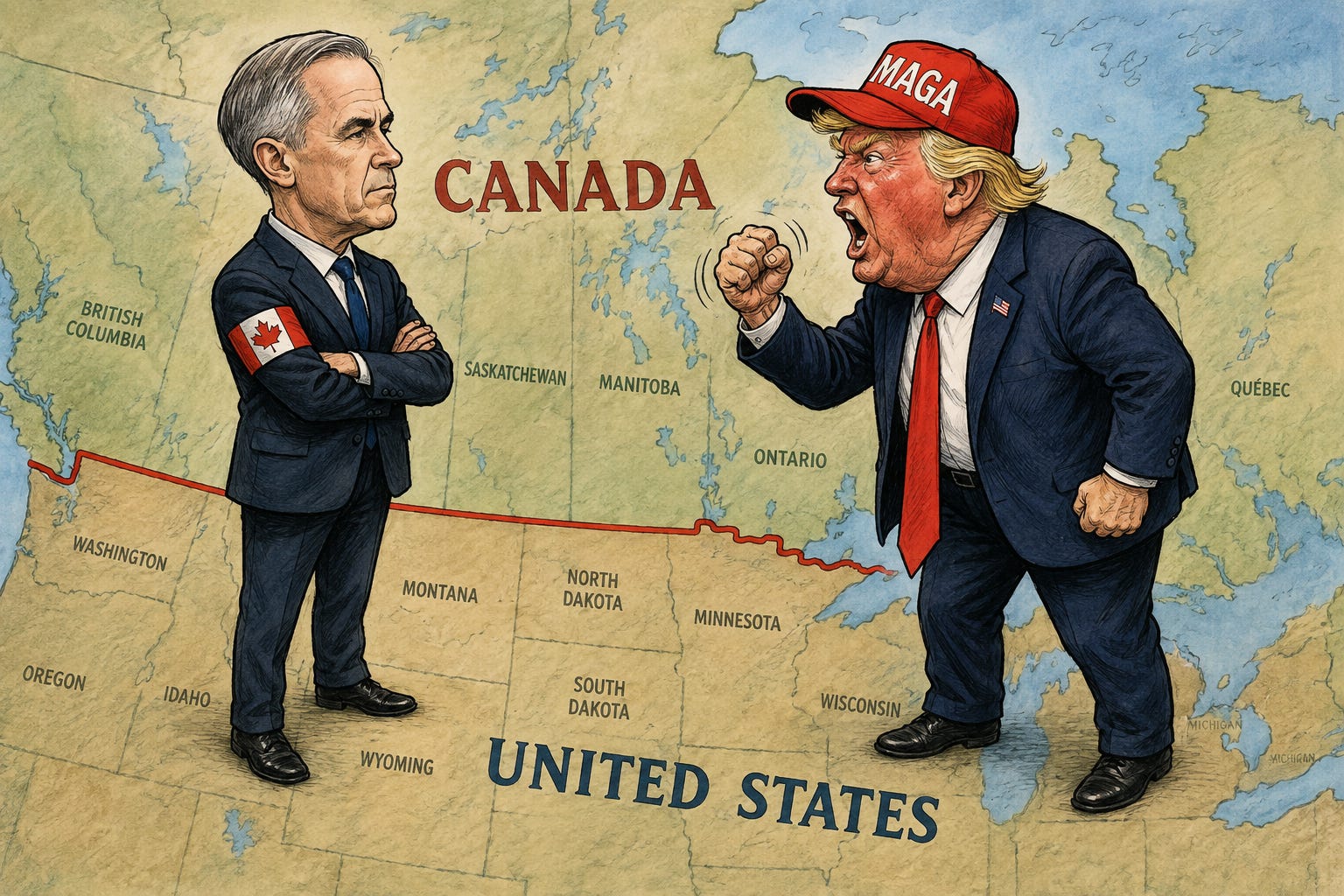
Thanks to the coincidence of a new school year upon us, psychologist Michael Ungar Ph.D. posted on Psychology Today (just today!) an article on how to deal with a bully. He equates bullying with the acting out of a narcissist. Oops, I gave away where I’m going with this — if my AI-generated cartoon wasn’t explicit enough.
Bullies need to feed their narcissism. They cannot stand it when someone tells them they are wrong. Or weak. Or flawed. They must always perceive themselves as smarter and more important than everyone else. They have, however, one flaw: Their need for attention means they need victims.
Several references converge on these strategies as superior to emotional retaliation or trying to reason with the bully:
Do not react emotionally: Bullies feed on the control and satisfaction of seeing an emotional reaction. Staying calm or neutral denies them that reinforcement.
Avoid capitulation or negotiation: Giving in, bargaining, or paying off a bully never works long-term. It only teaches the bully that aggressive demands yield results.
Walk away decisively: Physically or psychologically exiting the situation immediately demonstrates that the bully commands no authority over you.
Use brief, firm boundaries: Keep responses short, neutral, and clear (e.g. saying a calm “No” or stating that the behavior is unacceptable) without over-explaining.
Lean on informal networks: Support systems of peers who actively affirm self-worth provide a powerful buffer against the isolation a bully tries to create.
If you have seen and heard any of the clips of Prime Minister Carney since the collapse of the trade negotiations, you know that the first four of these strategies well describe his response and behavior. As for the fifth, nations isolated by a bully need allies just as individuals do. Mr. Carney made it clear that the U.S. has become an unreliable — even a hostile — partner and neighbor. He declared it time for Canada to foster new alliances and trading partners.
It had looked for several days as if the trade negotiations might be on track for a successful agreement. An excellent account of what went wrong can be found on today’s The Daily, the NY Times podcast which is also broadcast each afternoon on NPR. You can listen to it or read the transcript here. Entitled Canada Is Done With Trump, the reporting is based on:
…interviews with five American and Canadian officials with direct knowledge of the talks, two former U.S. officials, as well as seven senior industry leaders on both sides of the border who were briefed throughout. The interviews show that the red lines for the two sides were so far apart that it would have required major concessions, particularly by Canada, to come to a final agreement.
Of course, Trump himself wasn’t present in the negotiations, except by proxy. In this second term, he has managed to exert his will throughout the administration by recruiting minions and sowing fear. In these negotiations with Canada — which were being held in D.C. and actually making progress — his designated bully was Commerce Secretary Howard Lutnick, who appeared intermittently to drop bombs on settled issues.
In the end, however, it may have been more than economic issues that drove the Canadians from the table. In the final 48 hours, according to the sources in the room, several new U.S. demands were broached that were seen as undermining Canadian sovereignty.
The U.S. wanted Canada to commit to assuming whatever tariff policy the Trump administration adopted in the future. In other words, if Trump announced a new tariff on Brazilian steel in a few months, Canada would have to follow suit. Another last-minute issue was asking Canada to end its laws requiring streaming companies, including American ones operating in Canada, to give priority and prominence to Canadian productions and French language productions. This struck the Canadians as contempt for their cultural autonomy.
Canada was also asked to cancel their program called Buy Canadian, which tells government agencies to prioritize buying Canadian products for public sector projects. Many countries, including the United States, have a similar program. However, the U.S. would not even agree to reciprocate by offering to remove the tariffs the program was designed to counter.
These examples might be dismissed as negotiating stances, if not for the fact that most of them occurred at the 11th hour. Their cumulative effect was an erosion of trust in the process. But the thing that served as a neon sign reminder that Donald Trump’s America cannot be trusted was the response to the Canadian side repeatedly asking for assurances that any tariffs contained in a new agreement would not be revised. Bluntly, that the U.S. would promise to stick to its agreement. According to participants, at no point did the U.S. side make any such commitment. In fact, they insisted they retain all the power to change their tariff policy at will, even on goods covered by the agreement.
So Prime Minister Carney, for the second time this year (Davos in January), stood up to the biggest bully on the world’s playground. He looks the substantial statesman and steady leader while Trump posts that Lake Ontario should be renamed Lake America. Carney is laying out a vision of forging new relationships and alliances in a world that is growing ever more wary — and weary — of Trump’s America, which in turn is growing increasingly isolated.
It is going to be fascinating to see if Canada might set an example that other countries begin to follow. History suggests that giving in to an authoritarian bully can have horrific consequences, as happened after the Munich Agreement of 1938. This week, Mark Carney showed he is no Neville Chamberlain. Canada’s not backing down — and the world is watching.
Welcome back, Mike. An astute piece as always. Being a retired educator, you know bullies and narcissists and how to handle them. I just want to apologize to all Canadians for this buffoon. Hope we can undo the incredible damage he’s caused!